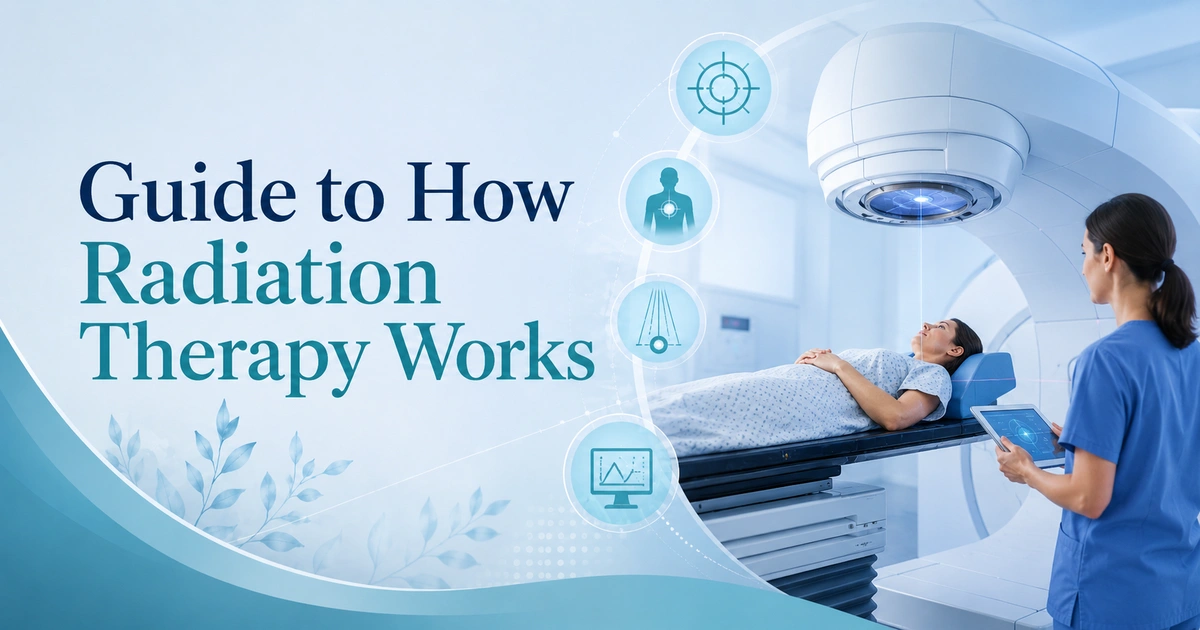
Radiation therapy, also called radiotherapy, is a cancer treatment that uses precisely directed high-energy beams – usually X-rays – to damage the DNA inside cancer cells. This prevents the cells from dividing and eventually causes them to die. Unlike chemotherapy, which circulates throughout the body, radiation therapy is targeted to a specific area, allowing a focused dose to reach the tumour while reducing exposure to surrounding healthy tissue.
Radiation therapy is used in more than half of all cancer diagnoses, either alone or in combination with surgery, chemotherapy, or targeted therapy. It can be given with curative intent – aiming to eliminate the cancer – or as palliative treatment to relieve symptoms.
What is Radiation Therapy (Radiotherapy)?
Radiation therapy uses high-energy radiation – primarily X-rays, but also gamma rays, proton beams, or electrons – to damage the DNA of cancer cells and prevent them from multiplying.
It is a localised treatment: the beams are aimed precisely at the tumour site rather than circulating through the body as chemotherapy does.
The two main methods of delivery are:
External Beam Radiation Therapy (EBRT)
A machine outside the body directs high-energy beams at the tumour. This is the most common form of radiation therapy and includes techniques such as IMRT, VMAT, IGRT, SBRT, and TomoTherapy.
Internal Radiation Therapy (Brachytherapy)
A radioactive source (such as seeds, wires, or a capsule) is placed inside the body, close to or within the tumour. This delivers a high, localised dose with very limited exposure to surrounding tissue. It is frequently used for cervical, uterine, prostate, and head and neck cancers.
How Radiation Therapy Works
Radiation therapy works by damaging the DNA inside cancer cells. When a cancer cell’s DNA is broken or disrupted, the cell can no longer divide successfully and eventually dies. This is the fundamental principle of how radiation destroys cancer tissue.
A key biological advantage is that cancer cells generally repair DNA damage less effectively than normal healthy cells. Treatment is therefore delivered in multiple small daily doses – called fractions – rather than a single large dose. This approach allows healthy cells surrounding the tumour to repair themselves between sessions, while cancer cells, which cannot repair themselves as efficiently, accumulate lethal damage over the full course of treatment.
This principle – called fractionation – is why most radiation treatment courses run five days a week over several weeks, rather than as a single session.
Step-by-Step: What Happens During a Course of Radiation Therapy?
A course of radiation therapy is a carefully planned, multi-step process overseen by a team of specialists: the Radiation Oncologist, Medical Physicist, Radiation Therapists, and Dosimetrist. Here is what each step involves.
Step 1: Consultation with a Radiation Oncologist
The Radiation Oncologist reviews your medical history, imaging scans, pathology results, and cancer type and stage. Together, you will discuss whether radiation therapy is appropriate and what the goals of treatment are (curative, adjuvant, neoadjuvant, or palliative).
Step 2: Radiation Planning and Simulation (CT Mapping)
A CT scan is taken with the patient in the precise position they will use for every treatment session. Customised immobilisation devices – such as a thermoplastic mask for head and neck radiation or a personalised body cradle – are created to ensure reproducibility.
Using dedicated planning software, the Physics and Dosimetry team designs the radiation plan: the angles, shapes, and intensities of the beams that will deliver the maximum dose to the tumour while protecting nearby organs (called Organs at Risk, or OARs).
At Onco-Life Cancer Centre, PET-CT Scan imaging supports accurate tumour localisation for radiation planning.
PET-CT Scan Locations at Onco-Life Cancer Centre
Step 3: How Radiation is Delivered – Daily Treatment Sessions
Treatment sessions are typically scheduled Monday to Friday. Each session is short – usually 10 to 20 minutes in the room – though the preparation and positioning may take a little longer. During the session, the patient lies still on the treatment couch while the machine moves around them. The radiation itself is invisible and painless.
Modern techniques used at Onco-Life Cancer Centre include IMRT (Intensity-Modulated Radiation Therapy), VMAT (Volumetric Modulated Arc Therapy), IGRT (Image-Guided Radiation Therapy), SBRT (Stereotactic Body Radiation Therapy), and TomoTherapy using the Radixact X9 system at Talegaon. Each technique optimises how the radiation dose is shaped and delivered. Your Radiation Oncologist will explain which technique is best for your specific cancer.
Step 4: Follow-Up Care After Radiation Therapy
Regular follow-up appointments are scheduled after treatment ends to assess the response and monitor for any delayed side effects. Imaging scans are typically performed at 4 to 8 weeks post-treatment and at planned intervals thereafter.
When is Radiation Therapy Used in Cancer Treatment?
Radiation therapy can be used at any stage of cancer, from early localised disease to advanced metastatic cases. How it is used depends on the stage, the tumour type, and the overall goals of the patient’s treatment plan.
The four main clinical roles are:
Curative or Definitive Radiation
Given as the primary treatment with the aim of eliminating the cancer completely. This approach is used in early-stage cancers or when surgery is not appropriate, for example in some cervical, head and neck, lung, and prostate cancers.
Neoadjuvant Radiation (Before Surgery)
Given before surgery to shrink the tumour and make removal more manageable. This is common in rectal cancer and locally advanced breast cancer.
Adjuvant Radiation (After Surgery)
Given after surgery to destroy any microscopic cancer cells that may have been left behind, reducing the risk of local recurrence. Frequently used in breast cancer, brain tumours, and head and neck cancers.
Palliative Radiation
Used in advanced cancer to control symptoms such as bone pain from metastases, bleeding, or pressure from a tumour. Palliative radiation does not aim to cure but can significantly improve quality of life.
Side Effects of Radiation Therapy: What to Expect
Radiation therapy affects some healthy cells along with the cancer cells, and this can cause side effects. All side effects are localised to the treatment area, except for fatigue, which is a general systemic effect.
General Side Effects
Fatigue is the most common general side effect. It tends to build gradually during the treatment course and typically improves over several weeks after treatment ends.
Localised Side Effects (By Treatment Site)
Skin
Redness, itching, dryness, or peeling in the treatment field – similar to sunburn.
Head and Neck
Mouth soreness (mucositis), difficulty swallowing (dysphagia), and dry mouth (xerostomia). TomoTherapy’s precision is particularly beneficial here, as it helps spare the salivary glands.
Abdomen and Pelvis
Nausea, loose stools, or urinary changes.
Scalp
Hair thinning or loss if the brain is in the treatment field; hair usually returns after treatment ends.
Most acute side effects are temporary and resolve within a few weeks to months after treatment. Your oncology team will provide supportive care guidance throughout the course.